top of page
MATH


WORKPLACE MATH
This course, offered in all years following grade 8, is meant for students who struggled to pass regular Math courses. It helps students develop foundational math skills to prepare themselves for future math courses required for graduation. Usually, only selected topics from the regular Mathematics curriculum for the respective grade will be covered, depending on each student's progress throughout the course. The majority of students that take these courses feed into future Workplace courses; however, if a student excels in the subject and shows a strong command over its core content and competencies, the teacher may recommend them to advance to regular Math courses. This course primarily tries to equip students with necessary mathematical knowledge and critical thinking skills that are required for most trades going straight into the workforce. Key topics are computational fluency, geometry, measurement, data and graph analysis, probability, trigonometry, and financial literacy. Advanced topics such as calculus, logarithms, and domains are left out, as they are futile and impractical for entry-level jobs that don't require further education. Students that take this course are rarely accepted into science-related university courses, and endure much more critical analysis from faculty and interviewers when applying to other courses.


FOUNDATIONS MATH
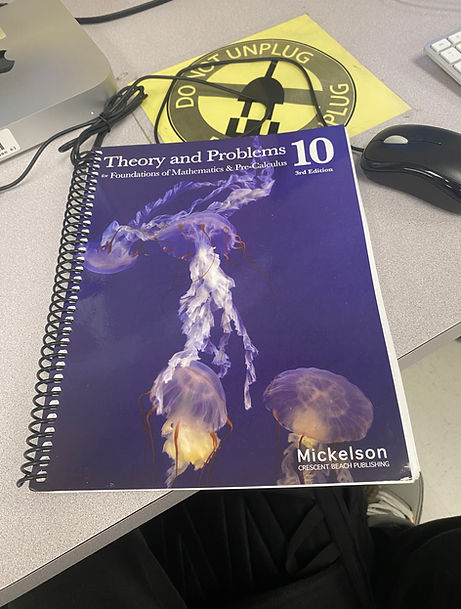
This course is offered in grades 10, 11, and 12, and acts as a median that lies between Workplace and Regular courses in Math; its curriculum focuses on elements that are required for further education or a career in the arts, and nothing more. Students are able to establish a foundation of mathematical competence, delving into topics such as mathematical reasoning. angle relationships, graph analysis, applications of statistics, scale models, as well as financial literacy, all while constantly reviewing previous years' curriculum in order to solidify the students' command over simple, daily life math problems. Please note that students and parents are encouraged to research the admission requirements for post-secondary programs since many top universities, such as UofT, UBC, Oxford, Cambridge, Stanford, Yale, etc., do offer a significant advantage to students that have taken the regular pre-calculus or AP course, even for students pursuing the arts. If a student's hope is to study arts at such a school, this course is not recommended for them; however, if they wish to not pursue further education, or if they wish to study at a less well-known university, this course is likely enough to secure a spot in the desired university course. It is advised that students look over application requirements regardless.

PRE-CALCULUS MATH
Pre-Calculus, offered in grade 10 and above, succeeds the regular mathematics courses in grade 8 and 9 and begins the three-year long transition students face prior to taking Calculus at university. This course is ideal for students who seek to pursue sciences at local universities and colleges, or perhaps, with some luck, in the arts at a top university, such as UofT, UBC, Oxford, Cambridge, Stanford, Yale, etc.; however, if the student wishes to have a higher chance of acquiring a spot at such schools in the arts or in the sciences, it is reccomended to take the AP courses offered at Palmer. The core curriculum consists of transformations and analyses of various functions used in higher mathematics, geometric sequences and series, as well as trigonometry, financial literacy, and will continue to focus on the mathematical processes learned in previous mathematics courses. Evidently, this course caters particularly to students that seek a higher education, enabling them to have a small chance at getting into their desired courses even at some of the world's best institutions.

INCENTIVE MATH
The creme of the crop, Incentive math is a challenging and rigorous course up to grade 9 that fully covers the student's concurrent level of math with an additional roughly 2/3 of the subsequent year. Starting in grade 8, the program is meant for highly motivated high school students who have an above average ability and interest in mathematics. Incentive mathematics 8 students should expect to tackle shapes and square roots, percentages, exponent law, fractions, linear relations and equations, polynomials, the Pythagorean theorem, and probability. According to the official Palmer Incentive website, students must maintain a 73% (B) average in the course. Else, students across both years risk being ejected from the program and being placed in regular mathematics the following year. It should be acknowledged that students in Incentive grade 9 mathematics will not be able to take pre-calculus 11 enriched the subsequent year if the student does not achieve at least an A average, even if they satisfy the 73% (B) average required to stay in the program. Rather, the student will be placed in a regular mathematics 11 pre-calculus course instead. As of September 17th, 2025, Mr. Michael Kwan teaches both incentive grade 8 and incentive grade 9 mathematics located upstairs in room 206.

REGULAR MATH
In general, all students will enrol in the same foundational math classes in Grades 8 and 9. At Palmer, the Grade 8 and 9 math regular courses cover a variety of key mathematical concepts, including: Perfect squares and cubes, Square and cube roots, Decimals, fractions, and percents, Rates, ratios, and proportions, Operations with fractions, Discrete linear relations, Expressions: writing, evaluating, and using substitution, Constants, Surface area and volume of various shapes, The Pythagorean Theorem, Financial literacy. To pass the course, students are required to achieve a minimum of 50%. Students will explore several big ideas in mathematics, including number sense, numeracy, patterns, computational fluency, geometry, data analysis, and problem solving. They will be encouraged to construct their own understanding of mathematics, apply math in meaningful contexts, and transition from concrete to abstract thinking by connecting concrete, pictorial, and symbolic representations. Furthermore, students will develop into investigative thinkers and build perseverance by tackling challenging problems. As of September 19, Mr. Li and Mr. Kwan are teaching these courses in Rooms 117 and 206, respectively.

MATH CLUB
R.C Palmer Secondary School is the home of the R.C Palmer Math Club. The club is split into junior (grades 8-9) and senior (grades 10-12) sections. Allowing all students across all skill levels, the R.C Palmer Math Club provides an opportunity for students to enhance their mathematical ability, often beyond their grade level of material. The math club also encourages its members to participate in various math competitions, exposing members further to various difficult math questions to enhance their knowledge and problem-solving prowess. Such competitions that the R.C Palmer Math Club typically participate in include the:
MathChallengersBC and Pascal contests (grades 8-9)
Cayley Contest (grade 10)
Fermat contest (grade 11)
Euclid Contest (grade 12)
Canadian Open Math Challenge (grades 10-12)
Canadian National Mathematics League High School Contest (grades 8-12)
Note, The Junior Math Club division is sponsored by Mr. Kwan in room 206 for grade 8 and 9 students
with meetings Thursday after school. The Senior Math Club division is sponsored by Mrs. Wang in
room 109 for students grade 10-12 with meetings every Monday after school. Each division has its own complement of grade 10-12 student tutors which help encourage members to expand their knowledge of the subject.
ENRICHED COURSES
Enriched courses are meant to challenge highly motivated high school students that demonstrate a sophisticated understanding of an academic subject. In terms of mathematics, R.C Palmer Secondary School offers the pre-calculus 11 enriched program. This course accelerates and goes more in-depth with the material done in a regular pre-calculus 11 course. Such material includes exponent law, radicals, polynomial factoring, rational expressions, quadratic functions, inequalities, and trigonometry. Unlike regular courses, admission is based off recommendation rather than automatic placement. Students are required to have achieved at least an (86%) A or above average in order to be considered. Students placed within this course are expected to participate in various math
competitions, including the Pascal and Gauss contests. As of September 17th, 2025, Ms. Yanei Wang teaches this course downstairs in room 109.
Teacher Interview Questions:
1. What is math all about?
2. Why is math important?
3. What is the general student opinion of math at Palmer.
4. How do you engage students who dislike math? Do you try to change their opinion on the subject?
5. In the perspective of a 12 year old you, what is your opinion of math?
6. Do you believe that math is present at Palmer in sufficient quantity?
7. What does math teach students outside of the curriculum?
8. What is something that Palmer does better than other schools when it comes to math?
9. What do you think the impacts of math are on the Palmer community, as well as society as a whole?
10. What's your favourite Math problem?
Student Interview Questions:
1. What course are you taking?
2. What do you enjoy about math?
3. What don't you enjoy about math?
4. How would you improve math at Palmer?
5. How has math helped you in life?




Interview with Mr. Li
New Recording 15
00:00 / 05:16


bottom of page